
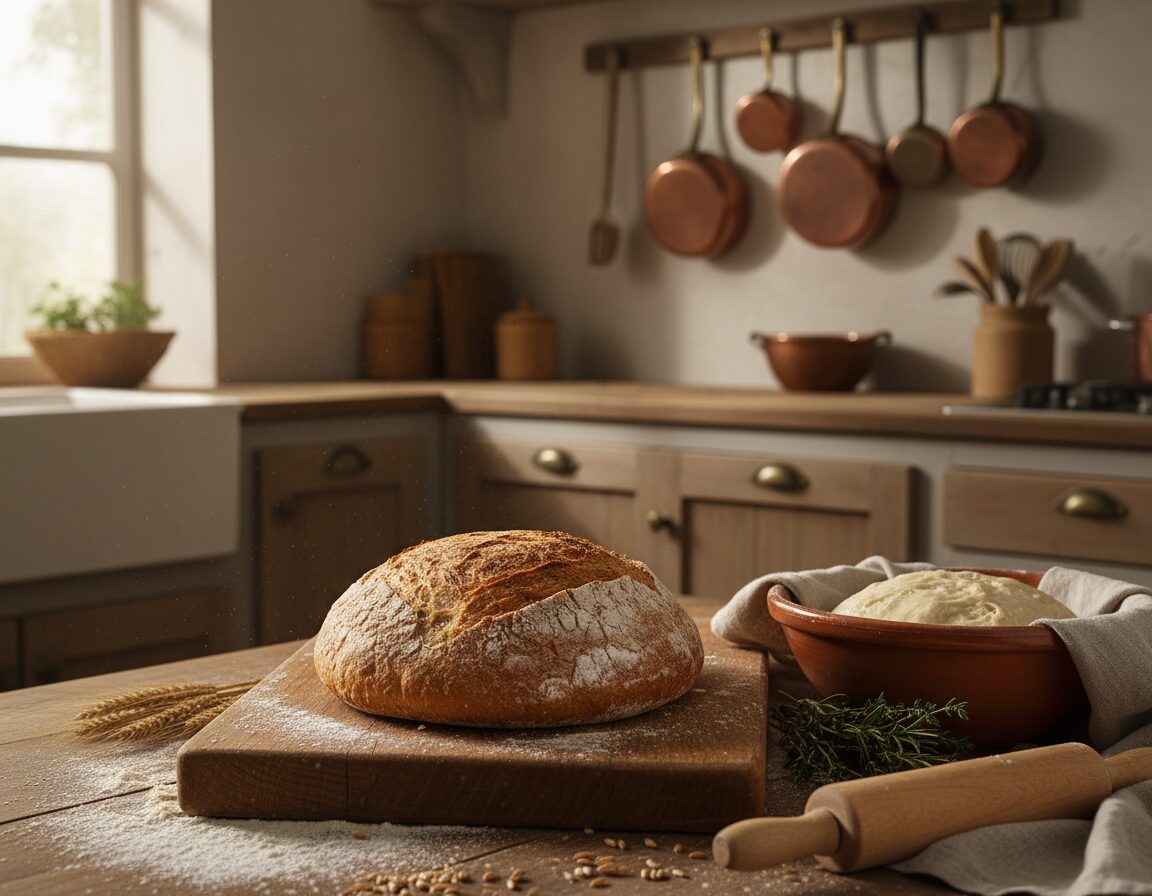
I’ve found that a simple no-knead loaf can be forgiving and fit around a busy day, so I’ll show you a straightforward approach to rustic bread baking that works in a standard UK oven.
I use only flour, yeast, salt and water — sometimes a splash of olive oil — and treat the process as three clear stages: mix, rise, bake. That way you always know what “good” looks like at each step.
I’ll share the tactile cues I rely on: how the dough should feel, what the surface looks like when it’s ready, and how colder kitchens change the timing. This is intentionally a little scruffy — a few rough ridges mean an artisan loaf, not a mistake.
Expect short hands-on time and mostly hands-off waiting. I’ll flag the main choices you’ll make — flour, yeast, and whether to use a dutch oven or tray-and-steam — and what to do when things wobble.
Key Takeaways
- Simple steps: mix, rise, bake — easy to follow in a small kitchen.
- Forgiving method: flexible rise times suit busy days.
- Look and feel: cues beat timers; learn the dough’s signs.
- Tools matter: dutch oven or tray changes crust and oven behaviour.
- Safety: hot cast iron and steam need care in a home oven.
- Result: a chewy, crackly loaf that reads artisan without fuss.
What I mean by “rustic” artisan bread (and what you should expect)
When I say “rustic” I mean a loaf that looks hand-made — a chunky, golden top and an open, chewy centre. I’m after honest results you can make at home: not a glossy bakery showpiece, but something with real character and great flavour.
The look and feel I’m aiming for: crackly crust, chewy crumb, big holes
I want a deep-golden crust that snaps when you tap it and a warm crumb that pulls apart with texture and chew. Large holes are lovely, but they depend on flour, hydration and oven heat — smaller holes can still taste brilliant.
Why this is beginner-friendly: no-knead, minimal hands-on time, forgiving dough
This method is deliberately low-effort. You spend a few minutes mixing, a little shaping, then long waits. Your hands do light work only — no mixer or elbow grease needed.
- What to expect: a sticky, awkward dough that bakes into an airy crumb.
- Crust development: steam first, then dry heat for that proper crackle.
- Forgiving factors: slightly cool or warm proves usually still give good rise with small tweaks.
- Sensory cues: the smell of browning and the sound of a cracking top tell you it’s ready.
Ingredients and kit I actually use for reliable results
I use four core ingredients that do the heavy lifting: flour, yeast, salt and warm water. Each one has a simple job: flour gives structure, yeast gives lift, salt adds flavour and controls fermentation, and water brings the dough together.
Choosing flour and handling hydration
In the UK I mostly use bread flour for a chewier crumb and bigger holes. Plain flour works fine too—it gives a softer bite and is what most people have at home.
Some flours feel thirstier. If dough seems dry, I add a splash more water. If it’s sloppy, I hold back.
Yeast and how I use it
I buy supermarket instant or active dry yeast. Instant mixes straight in. Active dry needs dissolving in warm water first—small change, big difference in reliability.
Basic kit I actually use
- Large bowl for mixing.
- Scraper or spatula to handle sticky dough.
- Scales but I note how to use cups if you must.
- Parchment paper for easy transfer and a cooling rack.
- A sharp knife for slicing once the loaf is cool.
| Item | Why I use it | Quick swap |
|---|---|---|
| Bread flour | More protein for chew and open crumb | Plain flour for a softer crumb |
| Instant yeast | Stir in and forget — consistent rise | Active dry: dissolve in warm water first |
| Bowl & scraper | Makes messy dough manageable | Deep mixing bowl and a spatula |
Rustic bread baking: getting the dough right from the first mix
Stand beside me at the bowl and I’ll show you how the dough should feel the moment you stir it together.
My target dough texture is wet, sticky and shaggy — not kneadable. You want a clinging mass that holds together. It should be too soft to shape into a neat ball. That’s the point: this dough will be loose and forgiving, not tidy.
Water temperature, plainly
I use warm water — pleasantly warm at the tap, not scalding. If it’s too hot to touch, it’s too hot for the yeast. A sensible upper guide is roughly 55°C/130°F, but I judge it by feel.
Adjusting hydration by feel
Follow my small-adjustments rule: add water in splashes and flour in light dustings. Mix for a minute between each tweak. This avoids overcorrecting and gives consistent results.
How I mix in minutes
I stir with a spoon or spatula for a few minutes, then scrape the sides so no dry flour hides. Push through the middle, fold the edges in, and give a final scrape. You want no dry patches and a uniformly sticky mass.
- If the mix feels floury and breaks apart → add a splash of water.
- If it spreads like a puddle → dust a little flour and mix briefly.
- Expect day-to-day changes — humidity, flour brand or kitchen warmth affect the feel.
Rising time, room temperature, and when I use the fridge for flavour
A reliable rise comes from reading the dough, not watching the clock — here’s how I judge it in a typical UK kitchen.
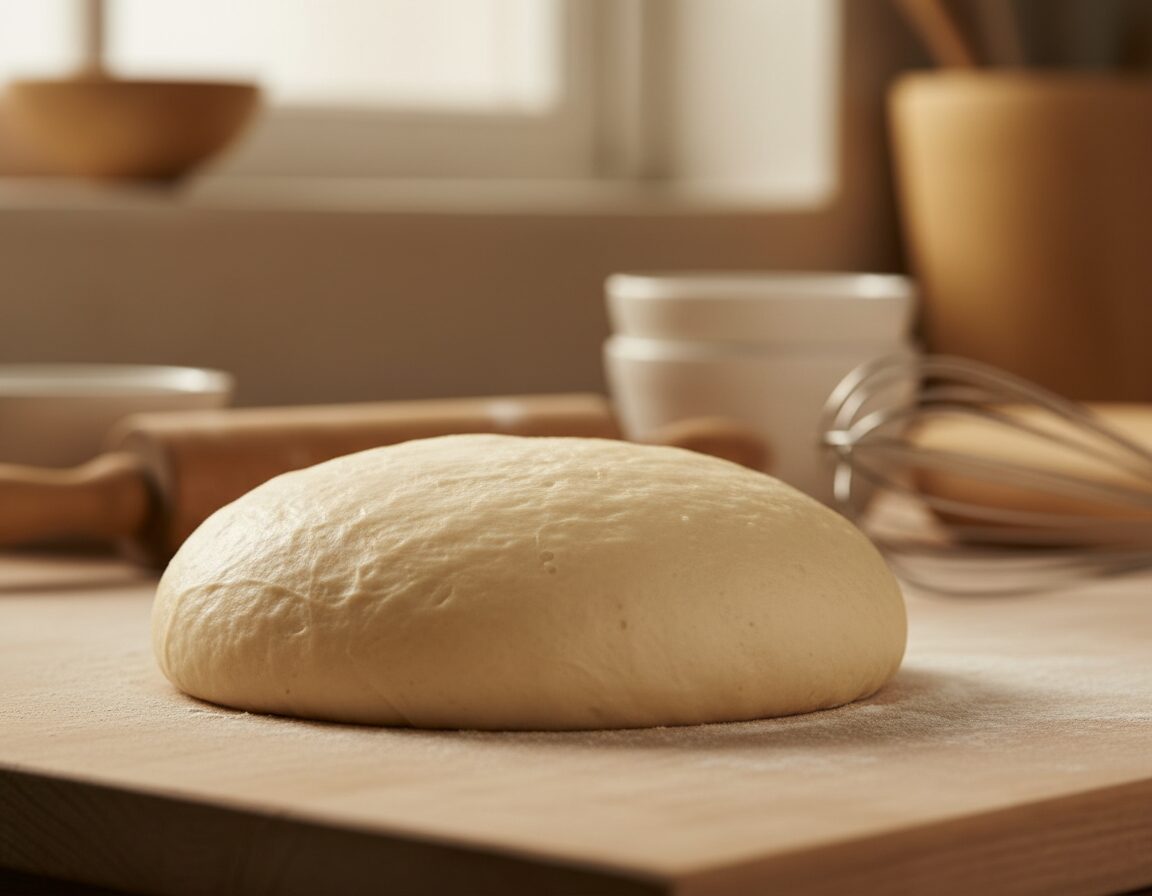
I aim for about 2–3 hours at a warm room temperature, but I watch for three cues: doubled size, a bubbly surface and a wobble when I nudge the bowl — like jelly. Those signs matter more than exact hours.
Homes in the UK are often cooler. If your room is chilly I leave more time — 4–5 hours is common on cold days. My favourite proving spots are a warm corner or the oven with the light on (oven off). I cover the bowl with a light wrap and a tea towel so the top doesn’t dry out.
Fridge proving and practical schedules
If I want better flavour I refrigerate the dough after the first rise. Slow cold proves give depth; I’ll chill for at least 8 hours and up to three days. Chilled dough can look a bit deflated — that’s fine.
Before baking I let chilled dough sit at room for about 45–60 minutes while I preheat oven. Cold dough won’t spring well straight from the fridge, so this short rest at room temperature helps recover the rise.
- Same-day: 2–3 hours at a good room temperature, then shape and bake.
- Later: Refrigerate after rise for 8–72 hours for flavour; bring out 45–60 minutes before you preheat oven.
| Scenario | Typical time | Key cue |
|---|---|---|
| Warm room (comfortable kitchen) | 2–3 hours | Doubled size; bubbly top; wobble |
| Cool room (UK winter) | 4–5 hours | Same cues — takes longer |
| Fridge proving | 8–72 hours | Slower rise; more flavour; let sit 45–60 mins before bake |
Shaping without stress (and without adding loads of flour)
You don’t need perfect technique to shape a nice loaf—just a few simple folds. I work calmly so the dough keeps its airy feel. I use a bench scraper and a lightly floured surface to stop it sticking to the counter.
Turning sticky dough out cleanly
I scrape the dough from the bowl onto the surface with one clean move. I avoid adding lots of flour—too much dries the crumb and kills big holes.
My simple fold-and-turn method
I fold the edges into the middle 4–6 times, rotate, then fold again. The scraper does most of the work so my hands stay fairly clean. I’m aiming for a loose round you can lift, not a tight boule.
Parchment paper transfer and why a scruffier top is fine
I place a parchment sheet beside the dough, flip or nudge the loaf onto it, then lift the paper into the pot or onto a sheet tray. I bake seam-side down for a smoother top, but imperfect tops bake into crunchy ridges that I actually like.
| Step | Tool | Goal |
|---|---|---|
| Turn out | Scraper, bowl | Cleanly move sticky dough |
| Fold-and-turn | Surface, few pinches of flour | Form a loose loaf without kneading |
| Transfer | Parchment paper sheet | Safe lift into pot or tray |
Baking in a dutch oven for steam, oven spring, and a proper crust
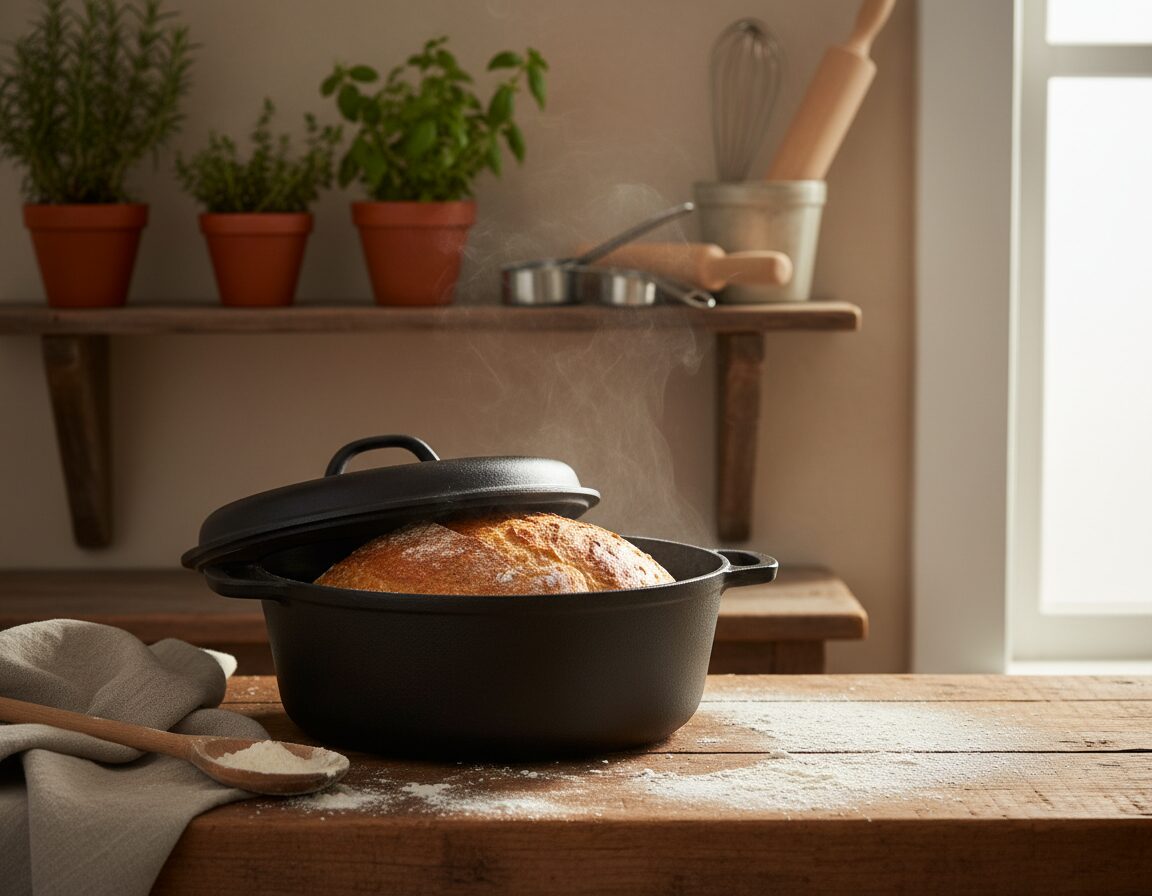
A hot covered pot is my secret for a big oven spring and a glossy, crackly crust. I preheat the whole setup so the dough meets maximum heat and trapped steam right away.
Preheat oven to 230°C/450°F with the dutch oven (lid on) inside. A cold pot steals lift; a smoking-hot pan gives the dough an extra push as soon as it hits the heat.
Timing I follow
I lower the loaf (on parchment paper) into the hot pot, cover and bake for roughly 30 minutes. That creates a steam chamber and helps oven spring.
After 30 minutes I remove the lid and bake a further 10–12 minutes to brown and crisp the crust. If your oven runs hot, shave a few minutes off the uncovered time and watch the colour.
Safe handling and finishing cues
- I use the parchment paper as a handle to lift the loaf—safer than grabbing the pot mouth.
- Set the lid on a folded tea towel, not the worktop, to avoid burns from hot cast iron.
- Cast iron stays dangerously hot long after it’s out of the oven—treat it with oven gloves.
| Step | Time (minutes) | Key cue |
|---|---|---|
| Lid on | 30 | Strong rise; glossy surface |
| Lid off | 10–12 | Deep golden top; crisp crust |
| Cool | At least 30 | Loaf sounds hollow when tapped; better results when cooled on a rack |
I judge doneness by colour, a cracking top and a hollow-ish sound when I tap the base. I let the loaf cool on a rack before slicing—this gives the crumb its proper texture and the best results.
No dutch oven? How I create steam and still get artisan bread results
I want the same early steam a covered pot gives — it helps with oven spring and a crisp crust. If you don’t have a dutch oven, you can mimic that environment with a tray and a hot metal pan.
Baking on a tray with a hot water pan: my go-to workaround
I shape the loaf on a parchment-lined tray so it slides in cleanly. I preheat the oven with an empty metal pan on the lower shelf for at least 20–30 minutes so it’s very hot.
When the oven is ready, I work fast: slide the tray in, pour boiling water into the hot pan, then shut the door. The trapped steam helps the crust set and the loaf rise.
Alternative setup: a preheated metal pan for boiling water (why I avoid glass)
I always use a metal pan for the water. Glass can suffer thermal shock and crack or shatter when you add boiling water to a very hot oven — it’s a real risk.
- What I use: a heavy metal pan for water and a parchment-lined tray for the loaf.
- Timing: pour boiling water quickly then close the door; baking time is similar to a covered pot — roughly 35–45 minutes depending on your oven and loaf size.
- What changes: crust may brown differently and be a touch less glossy than a dutch oven, but the result is still very respectable artisan bread.
| Step | Action | Key cue |
|---|---|---|
| Preheat | Oven to 230°C with metal pan inside | Pan very hot to accept boiling water |
| Load | Tray with loaf on parchment; pour boiling water into pan | Quick door close to trap steam |
| Bake | 35–45 minutes | Deep golden colour; firm crust |
Be careful of the steam plume when you open the oven — keep your face and hands back and use oven gloves. With a little practice this method gives reliable oven spring and a lovely crust, even without special kit.
Conclusion
A few simple habits make a big difference. Cool the loaf for at least ten minutes so the centre finishes, then slice and enjoy while it’s fresh — best in the first 1–2 days, then excellent toasted.
Quick recap: keep the mix wet, watch the rise cues, use a hot pot or steam, and don’t slice too early. For your next bake try a different flour, a slightly longer fridge rest, or a darker bake for a crunchier top.
Store in a paper bag or wrapped loosely; re-crisp a softened crust in a hot oven for a few minutes. Freeze portions up to three months and reheat slices from frozen.
Use leftovers for toast, sandwiches or as a hearty side with soup. If you want more ideas, try an Irish soda loaf recipe for a quick change-up. Trust the look, feel and sound more than the clock — it keeps this whole thing easy and repeatable.